When is mortgage default insurance required?
Mortgage default insurance is required when your down payment is less than 20% of the purchase price. This applies to homes priced under $1 million. Homes priced at $1 million and above require a minimum 20% down payment and are not eligible for default insurance from any of the three providers. This means buyers of million-dollar homes must have 20% down — there is no insured mortgage option at this price level.
If your down payment is 20% or more, you have a conventional mortgage and default insurance is not required — though some lenders may still purchase it to manage risk in certain situations. The premium savings of avoiding default insurance is one of the strongest arguments for saving a larger down payment.
Three insurers in Canada
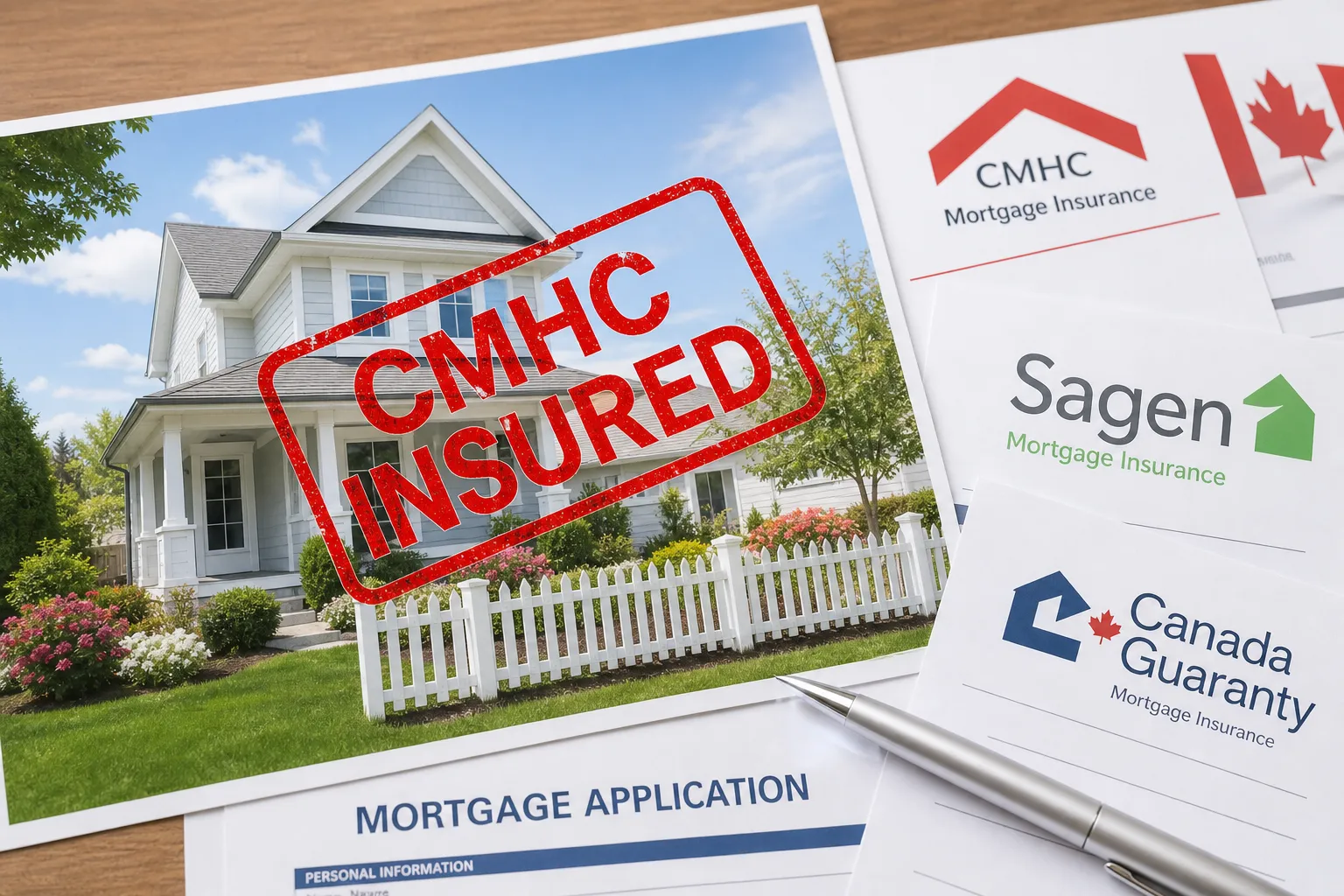
Canada has three mortgage default insurers, all regulated by the federal government under OSFI oversight. All three offer essentially the same coverage with minor differences in guidelines and pricing:
A federal Crown corporation. The most well-known insurer, insuring about 40-50% of all insured mortgages in Canada. Known for strict property standards and borrower guidelines. CMHC also conducts housing research and sets many of the policy standards that the other insurers follow.
A private insurer regulated by OSFI. Sagen insures roughly 35-40% of insured mortgages. Often considered slightly more flexible than CMHC on certain property types and borrower situations, particularly for condo financing and self-employed borrowers.
The smallest of the three, insuring about 10-15% of insured mortgages. Known for competitive premiums and flexible guidelines on certain file types, including non-permanent residents and alternative income documentation.
Your lender or broker typically chooses which insurer to use based on your specific situation and the lender's approved partners. You generally cannot choose the insurer yourself, but your broker can select a lender whose preferred insurer best fits your file.
Insurance premium rates (2026)
The premium is calculated as a percentage of the mortgage amount and varies by down payment size. The larger your down payment, the lower your premium rate:
- 5%–9.99% down: 4.0% premium — the highest rate, reflecting the highest risk to the insurer
- 10%–14.99% down: 3.1% premium — a meaningful reduction for an additional 5% down
- 15%–19.99% down: 2.8% premium — the lowest insured rate, just 0.3% less than the 10% tier
On a $700,000 home with 5% down ($35,000), the mortgage amount is $665,000. The CMHC premium at 4.0% would be $26,600. This is added to the mortgage amount, bringing the total to $691,600. The monthly payment impact of adding the insurance premium to the mortgage: at 4.29% over 25 years, the extra $26,600 adds approximately $144 to the monthly payment. Over 5 years, that is $8,640 in additional payments. Over the full 25-year amortization, the total cost including interest is approximately $46,500.
How to avoid paying CMHC insurance
The simplest way to avoid mortgage default insurance premium is to save a 20% down payment. However, for many buyers this takes years — during which home prices may rise faster than savings accumulate. Other strategies include using a gift from immediate family members for the down payment (accepted by most lenders with a signed gift letter), tapping into the Home Buyers' Plan (HBP) from your RRSP to supplement your savings, or buying a less expensive home where you can reach the 20% threshold. The break-even analysis: if saving 20% takes 3 extra years, and home prices rise 5% annually, the price increase on a $700,000 home would be approximately $110,000 — far more than the $26,600 insurance premium you are trying to avoid.
How the premium is paid
The premium is typically added to your mortgage amount rather than paid upfront. This means you pay interest on the insurance premium over the full amortization period. Ontario also charges provincial sales tax (PST) of 8% on the insurance premium. This PST is paid at closing and is not added to the mortgage. On a $26,600 premium, the PST would be $2,128 — an additional cost that must be paid from your closing cash.
Some buyers choose to pay the premium upfront rather than adding it to the mortgage. This avoids paying interest on the premium but requires additional cash at closing. If you have the cash available, paying the premium upfront saves the interest cost over the life of the mortgage but ties up funds that could be used for other purposes.
Refund of CMHC premium when refinancing
If you pay off or refinance your insured mortgage within the first 5 years, you may be eligible for a partial refund of the insurance premium. The refund is prorated based on how long the insurance has been in force. For CMHC, the refund schedule is: within 1 year — 100% refund (minus administrative fee), within 2 years — 75%, within 3 years — 50%, within 4 years — 25%, within 5 years — 10%. After 5 years, no refund is available. Sagen and Canada Guaranty offer similar refund schedules. This refund can be a meaningful benefit if you refinance or sell early in your mortgage term.