
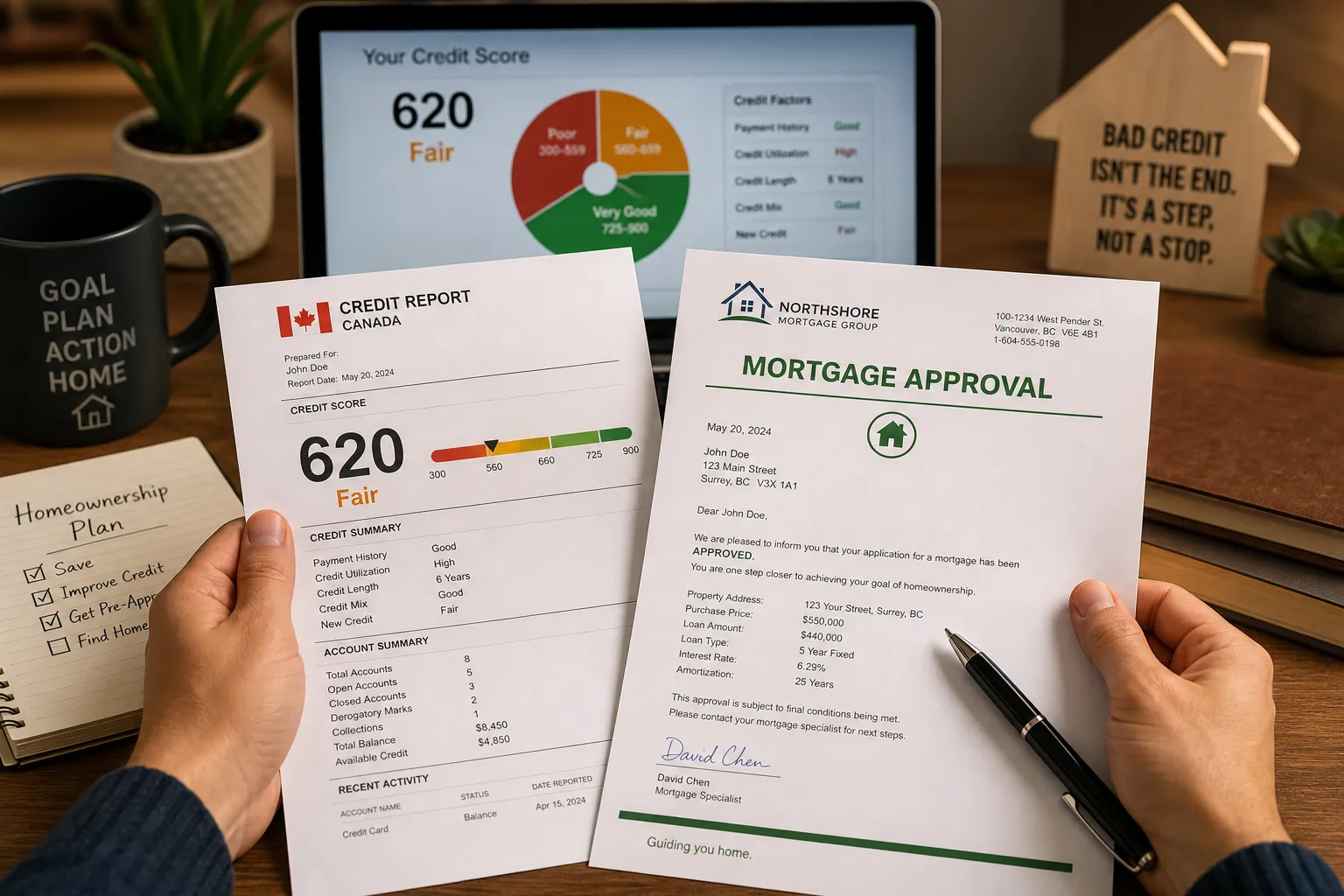
Understanding your credit situation
Mortgage lenders categorize credit profiles by credit score range. Knowing where you fall helps determine which lenders are realistic options:
- Prime (650+): Access to the best rates at major banks and monoline lenders. Most options available, lowest rates.
- Near-prime (600-649): Most B lenders and some A lenders with rate adjustments. Good options available with 5-10% down.
- Sub-prime (550-599): B lenders and alternative lenders, higher rates, larger down payments typically needed (10-20%+).
- Credit challenged (below 550): Private lenders focused primarily on equity rather than credit score. Requires 20-35% equity.
Your credit score is not the only factor — lenders also look at your payment history, credit utilization, length of credit history, and the specific nature of any credit events. A 580 score with a recent missed payment is viewed differently than a 580 score from high utilization with no late payments.
Credit events and how lenders view them
Different credit events have different impacts on mortgage qualification, and lenders vary in how they evaluate each type:
A few isolated late payments (30 days) are less concerning than a pattern of 60- or 90-day lates. Recent lates (within 12 months) carry more weight than older ones. Most B lenders can work with 2-3 late payments in the past year if there is a reasonable explanation.
Most lenders require the proposal to be discharged for 1-2 years before considering a conventional mortgage. Some B lenders consider borrowers while still in a proposal if equity (25%+) and income are strong. The proposal must be in good standing for at least 6-12 months.
Typically a 2-year wait period from discharge for B lenders, 7 years for prime lenders. Private lenders may lend immediately if equity is sufficient (30-35%+). The wait period starts from the date of discharge, not the date of filing.
Must be paid or have a payment plan in place. Some lenders require them to be satisfied before closing. Outstanding collections under $2,000 are sometimes overlooked by B lenders if the borrower has compensating factors.
Even without late payments, high credit utilization (using more than 50% of available credit) signals financial stress and lowers your effective credit score. This is one of the fastest things to fix — paying down balances to under 30% of limits can improve scores by 30-50 points within 1-2 months.
How to check and improve your credit score
You can check your credit score for free through services like Borrowell (Equifax) and Credit Karma (TransUnion). Check both bureaus before meeting with a broker, as scores can differ by 20-50 points between them. To improve your score before applying: pay all bills on time for at least 6 consecutive months, reduce credit card balances to under 30% of limits, avoid applying for new credit in the 6 months before your mortgage application, and dispute any errors on your credit report — inaccuracies are surprisingly common and can take 30-60 days to resolve.
The path from B-lending to prime
Most borrowers start with a B lender or private mortgage and transition to prime after rebuilding credit. Having a clear timeline helps set expectations:
- Years 1-2: B lender mortgage with on-time payments. Build a track record of reliability. Focus on paying down other debts and maintaining low credit utilization.
- Year 2-3: Monitor credit score improvement. Most borrowers see 50-100 point increases with consistent payments and reduced credit utilization. When your score crosses 650, start exploring prime refinance options.
- Year 3-5: Refinance into an A lender at prime rates. Savings of 1-3% annually on the mortgage balance. A $400,000 mortgage refinanced from 7.5% to 4.5% saves approximately $12,000 per year.
The transition timeline depends heavily on your starting point and how aggressively you work on credit improvement between application and refinancing. A broker can provide a personalized timeline based on your specific credit profile.
Strengthening your application before applying
Before reaching out to a broker, take these steps to maximize your chances of approval and improve the rates you are offered:
- Pay down credit card balances to under 30% of the limit — this is the single fastest credit improvement strategy
- Avoid new credit applications in the 6 months before applying — each hard inquiry dings your score
- Ensure all bills are paid on time, every time — set up automatic payments if needed
- Save for a larger down payment — 20%+ opens more lender options and better rates
- Gather documentation explaining any credit events — a written letter explaining circumstances (medical, job loss, divorce) helps lenders understand the context
- Build a larger down payment or existing equity — equity is the most powerful compensating factor for credit-challenged borrowers